The Four Bucket Framework ©
Making Complex Tax and Wealth Decisions Easy to Understand.
Tax is complex — not because the rules are complicated, but because decisions are made in isolation.
Most people are given advice one piece at a time:
- Tax minimisation
- Business profit
- Personal cash flow
- Superannuation
What’s missing is context.
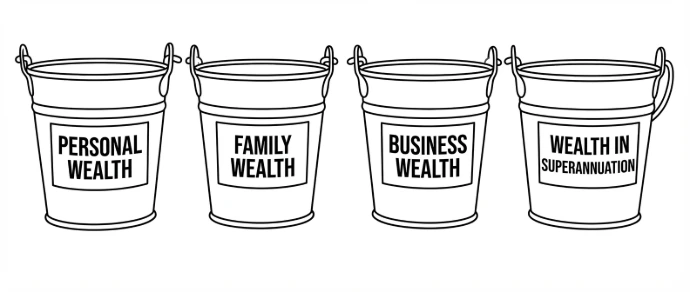
The Four Bucket Framework™ brings everything together so you can see where your money sits, where it should move, and why.

Why Traditional Tax Advice Feels Confusing
Most tax issues don’t exist on their own.
These are not “tax tricks”. They are consequences of moving money between different parts of your financial life.
Without a framework:
Decisions are reactive
Short-term tax savings create long-term pressure
Clients feel confused, not confident
The Four Bucket Framework changes that.
The Four Buckets Framework© Explained

Personal Wealth
Your day-to-day life
This bucket supports:
Living expenses
Lifestyle costs
Personal cash flow
Key question:
How does the business support my life today — sustainably?
When this bucket is ignored, personal cash flow pressure builds, even if the business is profitable.

Family Wealth
Protection, stability, and legacy
This bucket focuses on:
Risk management
Asset protection
Family security
Long-term continuity
Key question:
What happens to my family if something goes wrong?
Family wealth decisions are often invisible — until they are needed most.

Business Wealth
The engine that creates income
This bucket includes:
Business profits
Cash flow
Reinvestment decisions
Growth planning
Key question:
Is the business building real value — or just keeping me busy?
Too much pressure here can starve personal cash flow.
Too little discipline here destroys long-term wealth.

Superannuation Wealth
Long-term, tax-effective wealth
This bucket is about:
Retirement planning
Long-term compounding
Tax efficiency
Wealth quarantined for the future
Key question:
What money should be locked away long-term — and why?
Super is not an afterthought. Used properly, it is one of the most powerful wealth tools available.
Typical Issues of Miss Use of Bucket Company
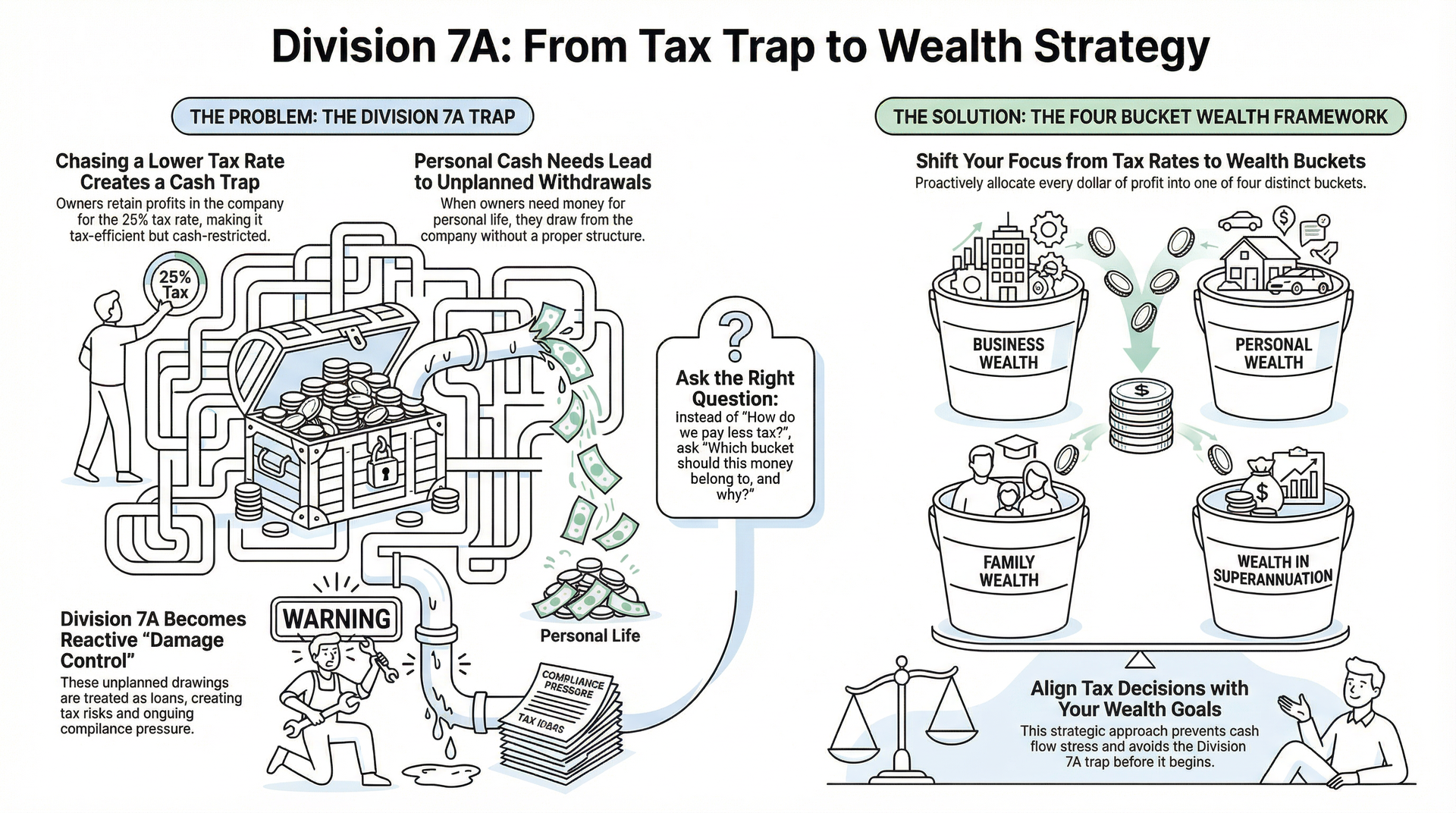
Division 7A exists because money moves from the Business Bucket to the Personal Bucket without a clear strategy.
Often this happens because:
Business owners chase the lower company tax rate (25%)
Profits are retained without long-term planning
Personal cash flow still needs to be funded
The result:
Unplanned drawings
Division 7A loans
Ongoing compliance pressure
This is not a tax problem. It is a bucket imbalance problem.
The Four Bucket Framework prevents this by asking:
Which bucket should this money belong to — now and in the future?
Div 7A Madness
Need help?
The Real Benefit: Clarity and Control?
The Four Bucket Framework:
Turns tax rules into practical decisions
Explains why certain strategies exist
Shows trade-offs clearly
Reduces reactive, last-minute decisions
Clients stop asking:
“What’s the cheapest tax option?”
And start asking:
“What’s the right decision across all buckets?”
How We Use the Four Bucket Framework?
We apply the framework to:
Accounting and reporting
Tax planning
Business strategy
Owner remuneration decisions
System design and automation
It becomes the common language for every financial conversation.
Who This Framework Is For
This framework works best for:
Business owners with growing or volatile income
Clients tired of confusing tax explanations
Owners who want confidence, not just compliance
People who care about long-term wealth outcomes
Start with Clarity
Every engagement starts with understanding how your money flows between buckets — and whether that flow is intentional.